Recap: Paw Patrol Got A Dedicated Pop-Up Channel On DStv

Also Read

Earlier this month, a lot of DStv consumers were alarmed to see Paw Patrol take up the whole schedule of Nick Jr I mean a full 2 weeks but what isn't that what PBS Kids did with Arthur a month ago perhaps it's coincidence or this is another indicator to cable becoming obsolete.

A lot of consumers may not be aware but Paramount had often launched pop-up channels dedicated to one of their current shows I mean they had one for Horrid Henry and another for SpongeBob most of these went to Nicktoons in those regions but now it will be a thing in Africa.

As it is, Paramount has been doing a lot of cost cutting for their Nickelodeon channels I mean Nicktoons is on autopilot at this point and Nick Jr. doesn't have much independency as seen already Africa and other parts of the world got 2 weeks of Paw Patrol.

If it's any consolation, Paramount+ is coming to South Africa within the following year and with Asia closing off Nickelodeon and Canadian operators losing exclusivity with Nickelodeon I'm expecting both Nickelodeon and Nick Jr. to become a graveyard for Paramount+.

It's already started with Nickelodeon as they got a lot of Paramount+ originals such as Big Nate, The Fairly OddParents: Fairly Odder, Star Trek: Prodigy and Kamp Koral with Nick Jr. grasping at its straws almost to the point of braindead Nicktoons.

The Paw Patrol Channel is just prove that cable is no longer the centre of attention. I wouldn't mind watching a day's worth of The Loud House but 2 whole weeks is just pushing it.


DreamWorks USA Is Falling Apart: The History Of Universal Kids

Also Read

On October 20th, 2004, the Public Broadcasting Service (PBS) announced a partnership with Comcast, HiT Entertainment (now Mattel Creations) and Sesame Workshop to create a new subscription based channel for aimed at children under the age of 4 kind of like Baby TV.

On April 4th, 2005, Comcast announced that the new kids channel would be called PBS Kids Sprout and it launched 6 months later on September 26. At first it launched as an on demand service then it got a channel later.

Unlike PBS Kids, the channel aired adverts however they were minimal and featured products aimed at babies and toddlers. Among the shows to air on the channel were Barney And Friends, Kipper, Pingu, Angelina Ballerina, Boobah, Calliou, Teletubbies and more.

In addition to airing many programming blocks, Sprout did something unique on the channel where it would take several short episodes of a show and combine it into a half hour show of its own complete with interstitials between segments.

2011 to 2013 saw a complex of business decisions that would lead NBC to get full control of the channel.

To summarise, Comcast claimed a 51% share of NBCUniversal at the time leaving them to handle the channel. Apex Partners sold HiT Entertainment to NBCUniversal and claimed their stake in Sprout. Sesame Workshop and PBS solder their share of Sprout forcing PBS to retract PBS Kids from the name by November 2013.

While all of this began in July 2012, Sprout began to run NBC Kids and Mi Telemundo respectively. This was a block that aired Saturday mornings aimed at younger children.

On September 26, 2015, Sprout recieved a refresh.

On May 1st, 2017, since Sprout was owned entirely by NBCUniversal. They announced that the channel would rebrand into Universal Kids and begin airing shows aimed at preteens at primetime hours. They would continue producing original content some from DreamWorks Animation that NBCUniversal purchased in 2016.

Unfortunately this change seemed to negatively impact the channel's viewership. It dropped by 30% in 2017 and a cut of 73% percent in 2018.

In June 2019, to try and recover Universal Kids financially they stopped producing new original content and shifted their focus to acquired series. But still in 2019 they were the lowest viewed channel in the United States with only 31,000 viewers per day luckily the decline dropped to 3%.

So it seems Universal Kids has fallen from its prime in recent years. Why is this?

I believe it is because of the brand change not everyone was familiar with Universal Kids even though it was the same channel. The new changes turned people off the channel. I think they could have slowed the rebrand perhaps add the changes to the lineup and take use of an intermediary name like Universal Sprout.

It seems like Universal Kids is in trouble and I mean soon to be terminated kind of trouble, can they dig themselves out of this?

At the moment, Universal Kids hasn't updated their programming and offers less and less content which often signals the downfall of a brand but with it being ranked the 132nd most watched channel in the United States one would hope but with cable becoming endangered I doubt.


Warner Bros. TV Layoffs: Studio Cuts 26% Of Workforce; Unscripted & Animation Divisions Merge; Workshop & Stage 13 Shuttered

Also Read

Warner Bros Television is cutting more than a quarter of its workforce as part of its parent company’s drive to cut costs.

The studio is cutting 26% of personnel, a total of 125 positions, across scripted, unscripted and animation.

It was mentioned on Monday that cuts would likely come today and we revealed earlier that Warner Bros. TV was shutting down digital production arm Stage 13 and its Warner Bros Television Workshop – a key plank in finding and mentoring new and diverse talent.

These cuts come with a number of structural changes put in place by chairman Channing Dungey, particularly in unscripted and animation. She called the move “incredibly difficult” as she pointed to a “tumultuous time” in the industry (read her full memo to staff below).

The television studio is the latest arm of Warner Bros Discovery forced to make cuts in order to save at least $3 billion after the merger overseen by David Zaslav. It comes after HBO and HBO Max laid off 14% of staff, around 70 people, in August.

The total number of employees losing their jobs is 82, some 19% of the current workforce, while Dungey and her team are also not filling 43 vacant positions. This means that there are a total of 125 positions eliminated.

UNSCRIPTED
On the unscripted side, which continues to be run by Mike Darnell, President of Warner Bros. Unscripted and Alternative Television, there are some strategic changes across its three divisions: Warner Horizon Unscripted Television, Telepictures and Shed Media.

The company is combining the creative development and programming roles across Warner Horizon Unscripted Television, which is behind series such as The Voice and The Bachelor, and Telepictures, which produces The Jennifer Hudson Show and previously made The Ellen DeGeneres Show.

Bridgette Theriault and Dan Sacks will run Warner Horizon, following the departure of Warner Horizon’s Brooke Karzen after 20 years. David McGuire will run Telepictures.

The move comes after the bringing together of many of the divisions’ back-end functions as part of a restructure in 2020 that saw Kevin Fortson, in physical production, and Matt Matzkin, in business affairs, legal and finance, work across all three divisions. Both Fortson and Matzkin remain.

Shed Media, which is behind series such as Bravo’s Below Deck Adventure and a number of The Real Housewives shows, will remain a stand-alone unit led by Lisa Shannon and Dan Peirson.

The studio is not merging Warner Horizon Unscripted Television and Telepictures fully, ostensibly because of the differences in the ways that the shows are produced. Warner Horizon makes union shows and Telepictures is non-union.

There will be no changes on the international side, where Warner Bros operates more than 20 production companies across the world, or at All3Media, which comes to the company via the Discovery ownership stake.

SCRIPTED
On the scripted side of the business, Brett Paul will remain as President of Warner Bros Television, which is not making any structural changes to the way that business is run, having previously brought together Warner Bros Television and cable/streaming unit Warner Horizon Scripted Television in 2020.

Clancy Collins White will continue to run development and Vicki Dummer will oversee current programming, both continuing to report to Dungey. Adrienne Turner will continue to run comedy development and oversee the comedy team. Adam Glick continues to serve as head of business affairs, Sue Palladino as head of production, and Mele Nagler as head of casting.

Cuts will be made at lower levels of this division.

However, the bigger moves in scripted was the closure of digital studio Stage 13 and the end of its workshops, which we revealed earlier Tuesday.

The scripted moves are a continuation of the TV group’s changing business, particularly an increasing focus on streaming and cable programming, which is thought to include around 65% of its current programming, amid the decline of broadcast TV.

This has been further extenuated by the ownership change at the CW, where Warner Bros TV and CBS Studios were the sole feeders of its scripted originals pipeline.

ANIMATION
In animation, Warner Bros Television is bringing together some of the creative and programming teams within two of its three animation studios: Warner Bros Animation and Cartoon Network Studios.

While current programming, casting, legal and business affairs had worked across all three (the group includes Hanna-Barbera Studios Europe), it will now bring together development and production teams at Warner Animation and Cartoon Network Studios.

The three labels will continue and will continue to be run by Sam Register.

The kids and family series development team will be led by Audrey Diehl, adult animation development will be led by Peter Girardi, and animated longform series development will be led by Sammy Perlmutter, with Bobbie Page leading main production. Ed Adams will continue as EVP and GM.

Shows that come out of these divisions include Invincible Fight Girl, Unicorn: Warriors Eternal and Adventure Time: Fionna & Cake.

The company said that multiple projects remain in active production and development and despite the restructuring, production output is “relatively unchanged.”

Here is Dungey’s note to staff today:

Team,

Today I write to you with sad news and a heavy heart. As many of you have already learned, some of our treasured colleagues will be leaving the company because of restructuring and realignment within our group. This was strictly a business decision, made as thoughtfully and compassionately as possible by studio leadership. But understanding that doesn’t make this moment any easier. These colleagues are more than just people with whom we’ve worked, they are part of our work family. We spend more time together than we do with most other people in our lives. Because of that, this loss is painful and difficult. For those impacted by the changes, I want you to know how grateful I am for your contributions – in some cases, spanning decades – and how deeply sorry I am.

There are a few changes happening within WBTVG that I would like to make specific note of here:

As part of the strategic realignment on the unscripted side, run by Mike Darnell, President, Warner Bros. Unscripted Television, we are making some changes aimed at finding synergies within the group, which includes Warner Horizon Unscripted Television, Telepictures, and Shed Media.

As you may have read yesterday, Brooke Karzen, head of Warner Horizon Unscripted Television, informed us in the last few weeks that she would like to try something new with her career after a highly successful 22-year run at the company. Brooke has been synonymous with The Bachelor brand for more than 20 years, overseeing the original show and developing The Bachelorette, Bachelor in Paradise, and many other extensions that have propelled The Bachelor into a global hit franchise. Her other successes include Emmy winner The Voice, Ellen’s Game of Games, and the Friends and Harry Potter reunion specials, to name just a few. Please join me in saluting Brooke for her tremendous accomplishments and wishing her the best in the future.

As a result of Brooke’s departure, Bridgette Theriault and Dan Sacks will now be leading Warner Horizon. We are combining some creative development and programming roles to work across both Warner Horizon and Telepictures, with David McGuire continuing to lead Telepictures. Lisa Shannon and Dan Peirson will continue to run Shed Media.

Working across all three unscripted divisions, Kevin Fortson continues to lead all aspects of physical production (including budgeting, scheduling, staffing, and more), and Matt Matzkinmaintains oversight of all business affairs, legal, and finance for unscripted series.

In Animation, run by Sam Register, President, Warner Bros. Animation and Cartoon Network Studios, we are implementing a new streamlined structure in which the development and main production teams will now work across both Warner Bros. Animation and Cartoon Network Studios. The kids and family series development team will be led by Audrey Diehl, adult animation development will be led by Peter Girardi, and animated longform series development will be led by Sammy Perlmutter, with Bobbie Page leading main production. This is an extension of the cross-studio teams that have already been in place for current programming, casting, legal and business affairs, and artist relations. Ed Adams will continue as Executive Vice President and General Manager.

On the scripted side, run by Brett Paul, President, Warner Bros. Television, our senior creative leadership team remains in place. Clancy Collins White continues to head up development, with Vicki Dummer as head of current programming. Adam Glick continues to serve as head of business affairs, Sue Palladino as head of production, and Mele Nagler as head of casting.

We will be closing Stage 13, which was founded in 2017 under the former Warner Bros. Digital Networks division as a studio for original digital shortform programming and has produced past series such as Special and It’s Bruno! for Netflix, Two Sentence Horror Stories for The CW/Netflix, and more. WBTV has already been supervising Stage 13 development and programming since 2020. Any existing Stage 13 projects in development will be absorbed within WBTV, which continues to be committed to finding new voices and providing opportunities for its richly diverse creative collaborators to tell authentic stories. I want to thank Diana Mogollón for her passionate leadership of Stage 13 and for the groundbreaking series that she and her team produced.

Also, following the conclusion of the current 2022–23 edition of the Warner Bros. Writers’ Workshop in April, we will be closing the Warner Bros. Television Workshop program, which includes both the Writers’ Workshop and the Directors’ Workshop. Both workshops have been instrumental in training the next generation of creative talent in the industry. While we will no longer have these formalized programs in place, we remain committed to developing and mentoring emerging talent and preparing them for careers in television.

As of this writing, all the impact conversations for WBTVG are complete. Out of respect to our colleagues, we will not be distributing a list of those impacted. Your direct managers will provide you with information about roles changing within specific groups. Your P&C partner will be available as well to address any questions or concerns. During this period of transition, please support each other, and be gentle with one another.

These are challenging times in the world at large, and a tumultuous time in our industry. For this kind of change to hit so close to home is incredibly difficult. But my hope is that these changes, made with an eye to a more focused business strategy, will strengthen and stabilize our company, maintain our great creative output, and better position us for continued future success.

Yet today we are losing members of our work family that we love, whose hard work has helped make our success possible, and for that I am truly sorry. I want everyone who is leaving to know that your contributions mattered, and the shows that you helped bring to life will always be part of the Warner Bros. Television Group legacy. Thank you for being part of our story.

With the deepest gratitude,

Channing


Roundups #102: Trevor Noah To Exit The Daily Show, Hugh Jackman To Return As Wolverine In Deadpool And Keanu Reeves No Longer Part Of Upcoming Series Devil In The White City

Also Read

Trevor Noah is exiting The Daily Show

It’s the end of the road for Trevor Noah’s tenure at Comedy Central’s The Daily Show. The comedian announced during the September 29 episode that, after seven years as host spanning back to 2015 when he took over for Jon Stewart, he’s decided to move on.

After noting that he recently reflected on fans’ support for the show on an international level, Noah told the studio audience that he found himself “filled with gratitude for the journey. It’s been absolutely amazing. It’s something that I never expected.” He went on: “And I found myself thinking throughout the time, you know, everything we’ve gone through: the Trump presidency, the pandemic, just the journey of, you know … the more pandemic. And I realized that, after seven years, my time is up. But in the most beautiful way. Honestly, I’ve loved hosting the show. It’s been one of my greatest challenges. It’s been one of my greatest joys. I have loved trying to figure out how to make people laugh, even when the stories are particularly shitty on the worst days. We’ve laughed together, we’ve cried together. But after seven years, I feel like it’s time.”

A Comedy Central spokesperson released a statement on Noah’s departure after his announcement was posted to Twitter: “We are grateful to Trevor for our amazing partnership over the past seven years. With no timetable for his departure, we’re working together on next steps. As we look ahead, we’re excited for the next chapter in the 25+ year history of The Daily Show as it continues to redefine culture through sharp and hilarious social commentary, helping audiences make sense of the world around them.”

Hugh Jackman returns to the MCU

The Wolverine is back as Hugh Jackman gets back in the gym to once again sport the muscular frame of the beloved X-Men character. It has now been confirmed that Jackman will reprise the role of Wolverine in the upcoming Deadpool 3, an announcement that came as a huge surprise to Marvel fans.

Hugh Jackman first played the role of Wolverine over two decades ago in the first X-Men outing. While the actor was praised for his portrayal, Jackman has since revealed that he only had a few weeks to prepare. Hence, why his physique is far less impressive than it would eventually become. Jackman has now played the role multiple times, each time putting in the hard work to bring the Marvel superhero to life in live action, with the actor often topping the list of the greatest physical transformations.

While the plot of Deadpool 3 is currently unconfirmed, it is looking more and more likely that the threequel will follow Wolverine and Deadpool embarking on a road trip. Something that Ryan Reynolds seemingly revealed last year.

Keanu Reeves no longer making his first major American television role debut

Keanu Reeves will no longer star in the Hulu series adaptation of “The Devil in the White City,” Variety has learned exclusively from sources.

The show was first put into development at Hulu in 2019 and was officially ordered to series at the streamer in August 2022. It is based on the book of the same name by by Erik Larson.

Per the official logline, the show “tells the true story of Daniel H. Burnham, a demanding but visionary architect who races to make his mark on history with the 1893 Chicago World’s Fair, and Dr. H. H. Holmes, America’s first modern serial killer and the man behind the notorious ‘Murder Castle’ built in the Fair’s shadow.”


Roundups 101: Disney Animation Television Unveils Upcoming Series Kiff, First Look At HBO Max Upcoming Series Velma And Chris Pratt Is Super Mario In Explosive Sneak Peek

Also Read

Kiff currently in production, slated for 2023

Kimiko Glenn (“Orange Is the New Black”) and H. Michael Croner (“Craig of the Creek”) have been cast as voice-over co-stars in Disney Branded Television’s upcoming animated series “Kiff,” which will premiere in 2023 on the Disney Channel.

“Set in a world where animals and magical oddballs tackle day-to-day life alongside one another, the series follows Kiff and Barry as they navigate school, relationships and their often eccentric community,” according to the show’s longline. Music will also play a role in the series, with a new original song in every episode.

Besides Heavens and Smal, the show’s creative team includes co-producer and story editor Kent Osborne (“Phineas and Ferb” “Adventure Time”), who will serve as co-producer and story editor, and Winnie Chaffee (“Captain Planet and the Planeteers”) as producer. “Kiff” is produced by Titmouse in association with Disney Channel.

Velma is getting an origin story

There's been a lot of chat about Scooby Doo's Velma Dinkley lately, largely because the release of Amazon Prime's Trick or Treat Scooby-Doo!(opens in a new tab) revealed that the character is gay. Fans rejoiced, and so did Google.

So there's more than enough intrigue to fuel HBO Max's Velma, an entirely separate work that intends to play out as an origin story for Velma and the rest of the gang. The adult animated series will not feature the beloved, mystery-loving dog Scooby.

The titular character is voiced by Mindy Kaling, whose sass and signature charm do wonders for the role, at least from what the teaser suggests. Kaling co-created he series alongside Charlie Grandy.

Nintendo is launching another feature film

Start gearing up your (animated) engines, because another film based on Nintendo’s Super Mario video game franchise is coming out soon. The movie, which is officially titled The Super Mario Bros. Movie, is an animated project with a voice cast made up of some of Hollywood’s biggest stars. Plans for the next Mario film started way back in 2016, but production didn’t officially kick off until 2020. This is the third feature film adaption of the video game franchise. The first was the 1986 anime film, Super Mario Bros: The Great Mission to Rescue Princess Peach! That was followed by the 1993 live-action film Super Mario Bros., which starred Bob Hoskins, John Leguizamo, Dennis Hopper, and Samantha Mathis.

The Super Mario film will be released in theaters on April 7, 2023 in the United States. The movie was previously scheduled to come out December 21, 2022, but it was delayed by a few months.


NBCUniversal International To Close E! In Germany, Austria And Switzerland By The End Of 2022

Also Read

During the week, Broadband TV shared the news that NBCUniversal will be axing their female skewed celebrity based E! channel by the end of 2022 for strategic purposes.

“For strategic reasons, the channel E! Entertainment will be discontinued at the end of the year,” a Sky Deutschland spokesman confirmed to Broadband TV News. “We are fully concentrating on our very successful pay-TV channel brands 13th Street, SYFY and Universal TV, providing our customers with an exciting and broad entertainment portfolio,” said the Sky spokesman.

Both NBC Universal and Sky Group are part of US media company Comcast.

Of course this entail doesn't state what fate awaits the rest of NBCUniversal's linear offering globally or in this case E! Entertainment as traditional TV is becoming a waste for OTT platforms like Disney+ and Netflix.

NBCUniversal will be rolling out a new streaming service Universal+ in South Africa from October 14th exclusively on MultiChoice's Explora Ultra supplying content already viewed on various channels including Telemundo, Universal TV and DreamWorks Channel.

Rich Knight: 5 Reasons Michael Jackson's Moonwalker Was A Childhood Horror

Also Read

A lot of people talk about how that boat scene in Willy Wonka and the Chocolate Factory, or the Wheelers in Return to Oz, really messed them up as children. And most of the time, those people are joking. Yes, those scenes and characters were bizarre and didn’t really fit in a “kid’s movie.” But they didn’t really mess anybody up, either. They were just creepy. Well, I’m here to tell you that the Michael Jackson movie, Moonwalker, which came out in 1988, and pretty much consisted of a few music videos strung together, legitimately did mess me up as a child.

And it’s because it slipped into my subconscious. Growing up, there are a lot of things connected to Moonwalker that I didn’t even realize were from this film that seriously freaked me out as a child, and I didn’t even know why. You might be wondering how this happened, and I can tell you. But do I want to? Yes. Yes, I do. Because it will be therapeutic for me, and I have to start somewhere, right? Annie, am I okay?

I Used To Think I Dreamt This Movie

There are two movies that I thought I dreamt but could have sworn were real. One was a sequel to Willy Wonka and the Chocolate Factory that actually turned out to be a live-action version of The Little Prince, starring Gene Wilder. And the other was Moonwalker . Strangely enough, I was more convinced that the Willy Wonka and the Chocolate Factory sequel was real since there is actually a sequel to the book called, Charlie and the Great Glass Elevator.

But Moonwalker was the movie that was too weird to be real. In my dream of the Charlie and the Chocolate Factory sequel, Willy Wonka and Charlie land in a forest with their elevator, and these little creatures pop out behind trees. That’s all that I “remembered”. But in Moonwalker, I could have sworn I remembered these clay figures chasing Michael, and him turning into a robot. Obviously, that was all just a dream…wasn’t it?

Segments In The Movie Became Actual Music Videos

And here’s why my lizard brain almost believed it was all just a dream. It’s because many of the segments in the movie actually became music videos. This is because Moonwalker isn’t really a movie, per se, as it is just a bunch of music videos that are loosely strung together. “Man in the Mirror,” “Speed Demon,” “Leave Me Alone,” and of course, “Smooth Criminal,” are all featured in this film.

And it’s weird that I didn’t believe this was a movie since I had the Michael Jackson Moonwalker video game for my Sega Master System. I played the hell out of that game, and I loved it. It was a platformer (of sorts) where you had to rescue children by opening doors. It was really fun, but something didn’t quite sit well with me when it came to a trench-coat-wearing bad guy with sunglasses. There was nothing really scary about this character. But then I saw the movie…

Joe Pesci Always Scared Me As A Child And I Didn’t Know Why

I found out that Moonwalker was a movie while watching an episode of The Angry Video Game Nerd . In the episode, which was about the Moonwalker game, the Nerd briefly mentioned that the game was based off of a movie, which made my heart leap into my throat. All those years where I just thought I imagined the movie finally came crashing home. I got goosebumps and had to see if it was real. When I found out that it was, I watched it and finally understood why I had an irrational fear of Joe Pesci growing up.

Because while most kids of a certain age found Joe Pesci to be funny as the short-tempered thief, Harry, in Home Alone, I always found him terrifying. For some reason, I thought he was either going to kill Kevin, or take him hostage and pump him full of drugs, which didn’t make any sense. Why would he give Kevin drugs? Well, it turns out that Joe Pesci plays a character named Mr. Big in Moonwalker, and he’s the main antagonist. And get this. He wants to make all the kids in America drug addicts, and even kidnaps a child. It gets worse…

I Had An Irrational Fear Of Being Kidnapped When I Was Growing Up

Parents always try to scare their children when they tell them about strangers so their kids don’t get kidnapped. So of course I had a fear of being taken. But my fear of being kidnapped was really bad. So much so that I had several nightmares about being taken to a lair where armed guards stood watch while my captor lurked in the shadows. Well, I now realize it was all because of this stupid movie that I was so afraid of being kidnapped.

In the film, there’s a segment that eventually became the video “Smooth Criminal.” I’m sure you’ve seen it—the white suit, the bending forward, the pool hall. All that good stuff. Well, in the movie, after the big music number, Mr. Big (Joe Pesci) kidnaps an orphan child and ties her up, threatening to inject her with drugs. And after I saw that, it all made sense to me why movies like Goodfellas and even My Cousin Vinny always gave me intense anxiety. But that wasn’t even the worst part…

Robot Michael Jackson Is Nightmare Fuel

No, the worst part, and the part that actually made me scream as a grown ass man, was when Michael Jackson turns into a robot. It was something of a primordial, distant memory that struck me right in my heart when I saw him transform into a robot and shoot down people dead. Dead!

And what’s really strange is that this scene is also in the video game, but my mind didn’t make the mental leap. Seeing it on the screen just cleared up so many holes for me as to why I always loved MJ growing up, but was also really, intrinsically frightened by him. So much so that I couldn’t look at his picture for too long or I would feel really unsettled. I always thought it was because of his “Thriller" video, but no. It was Moonwalker and Robot Michael Jackson. 100% Robot Michael Jackson . That scene is terrifying. And those are my 5 reasons.

South African TV And Media Personality Thaamir Moerat Will Star In A German Reality TV Show

Also Read

South African TV and Media personality Thaamir Moerat will star in a German Reality TV show called "Wo die liebe hinfällt" (Where Love Falls) which will air on the popular VOX channel in Europe.

The show centers around couples whose love is unusual being exposed to society's gaze every day and how they deal with criticism and opposition.

Thaamir currently hosts the lifestyle show Prime Culture in South Africa, Sunday nights on DSTV 345 and is the owner of the global 1-minute film festival.

Wo die liebe hinfällt focuses on his life with German model and TV personality Nadja Cleven in Germany and South Africa, and the difficulties of integrating into a different country and adapting to the German culture and customs.

"When I was approached by the network I just laughed and thought why not. I did reality TV back in South Africa before with the 2 season 13 episode sales show "Sell Hard" years ago, and then again with Mr South Africa "The Journey" where I was head judge in 2013/14. So, I know what I'm getting myself into. Wo die liebe hinfällt will be fun and entertaining as it was a difficult transition for me setting up a base in Aachen with Nadja and our son Naeel. I'm just having a laugh anyways," said Moerat.

Nadja added that she was hesitant to show their lives on national TV but warmed up to the idea eventually.

"Thaamir's life is a reality TV show, and he loves the public persona, but I prefer going about my business and keeping my private life private. I'm very German in that sense," said Nadja.

The show will be filmed during October at their residence in Germany and back in South Africa during November and December and will be aired on the Popular Vox network in Germany during January 2023.

Local viewers will have to wait for the YouTube episodes to be uploaded.

Doug: Things Only Adults Noticed About The Once Popular Cartoon

Also Read

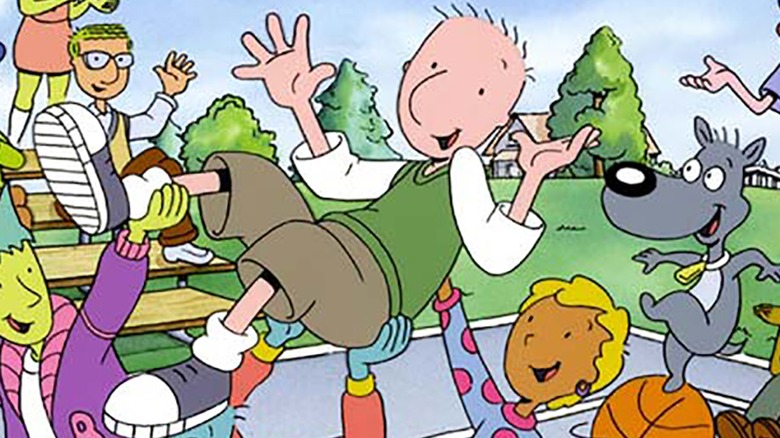
Not all cartoons have to be about superheroes, space adventures, or anthropomorphic animals. Sometimes, it's enough to tell the story of one kid, his friends, and the town they're growing up in. Such is the case with Doug, the 1991 animated series about a boy who loves his dog, his banjo, and hanging out with his best friend Skeeter at the Honker Burger.

Doug is entirely original, not based on a comic book, toyline, or movie property, like so many other cartoons of the 1990s. It was one of the first Nicktoons, along with Ren & Stimpy and Rugrats, and was so extensively developed, it had a show bible that detailed the floor plans of its characters' houses. Today, Doug is remembered for its stylish animation, heartfelt storytelling, and unconventional soundtrack. Yet much of Doug goes over the heads of its youngest viewers. From the subtlest character choices to the most overt references, these are the Doug details only adults appreciate.

Dear Diary...

Douglas Yancey Funnie is a shy, self-conscious kid. When he isn't drawing, playing his banjo, or working up the courage to talk to Patti Mayonnaise, he's daydreaming. Doug's world, and the cartoon that chronicles it, is hugely interior: Doug's journal, chock-full of superhero drawings and l'esprit de 'l'escalier comebacks, is the backbone of the show.

This deeply personal approach is by design: Doug was created by Jim Jinkins as a largely autobiographical take on adolescence. Jinkins tried to sell Doug as a greeting card line and children's book before a version of the character wound up in a grapefruit commercial. Ultimately, Jinkins' creation took root at Nickelodeon, in large part because of its honest, down-to-earth storytelling.

Executive Producer Vanessa Coffey had worked on cartoon giants like Teenage Mutant Ninja Turtles for other networks, and had grown tired of their violence and commercialism. Jinkins' Doug was a breath of fresh air, and Coffey had a hunch kids would respond to it. She was right: 98% of a test group of 800 kids enjoyed Doug. "It's sad," Coffey expounded, "There are shows you can give children that are smart, that will appeal to them. Kids like to think. They don't want to be given guns and sugar." In that sense, Doug's down-to-earth spirit is something kids and adults appreciate. But only the latter group truly understands how daring the series is — especially at the time of its creation.

Disney's Doug

After 52 glorious episodes, Doug's creators prepared to produce a final season, as Nickelodeon had previously ordered — only to find that Nick was no longer interested in funding it. Disney still saw promise in Doug, however, and Jinkins had more stories to tell, so the Funnie family moved to the Mouse House. Under Disney, Doug would remain profitable — even more so with a marketing machine behind it — and produce another 65 episodes, as well as a movie. 

But Disney brought some major changes to Bluffington. Doug himself aged another year, and his family welcomed a younger sister named Cleopatra Dirtbike Funnie. Roger Klotz became rich. The Honker Burger vanished. Most noticeably, Doug's voice actor, the legendary Billy West, was replaced by Tom McHugh. Jinkins wanted West to return, but Disney had pushed him too far by asking him to do additional voices for the same amount of money.

Though kids noticed the changes, they had to grow up to truly grasp the reasons behind the revamp. It is obvious to adult eyes that all of these changes made Doug a whole lot less complex, and a whole lot more commercial. Disney's Doug isn't terrible, but it gives kids a lot less to wrestle with. As Patti Mayonnaise's voice actress Constance Shulman put it, Disney "just dimmed the magic."

Relationships of every stripe

Patti Mayonnaise is the girl of Doug's dreams. But she's also one of the audience's first encounters with Doug's multifaceted approach to relationships and romance. Patti is kind, brave, and smart — and the child of a single father. Later, her father remarries, and Patti experiences life with a step-parent. Roger is the child of a single mom, the Dinks are married without children, Chalky lives with his dad and older brother — Bluffington features all sorts of families built around all sorts of relationships.

This openness and maturity extends to the show's portrayal of dating and romance. In "Doug & Patti Sittin' in a Tree," Doug attempts to distill dating into discrete steps ... only to learn, of course, that no relationship can be turned into an equation. The lesson hammered home over and over again over the course of the series is that love is personal, and never a game to be won or lost — a lesson many adults could still stand to learn.

But it's not all high-minded idealism when it comes to Doug's portrayal of adolescent feelings — there are more than a few sly jokes snuck into the series. For example, when Roger realizes his cat has had kittens, he exclaims that he doesn't know how to tell their sex. His mother, exasperated, says they are "way past due for a very important talk." Cue parental laughter and kid confusion.

The bully's-eye-view

Bullying is very much a part of Doug. Creator Jim Jinkins was working from personal experience — He actually invited his childhood bully to the premiere of Doug's 1st Movie, only to discover the kid in question had been contending with bullies of his own. No surprise then that the cartoon's depiction of bullying is complex, encompassing the pain they cause as well as the pain they are acting out of.

Roger Klotz is Doug's particular tormentor, and is remarkably fleshed out over the course of the series. Fans see Roger struggle with being held back in school, first crushes, and growing up poor. He and Doug end up something close to friends in the end, to the point that Doug is the only person Roger trusts to take care of his beloved cat. Kids appreciate seeing their struggles on screen, but only adults understand how daring Doug truly is in depicting Roger's circumstances with such honesty. Nothing he's gone through makes bullying okay, but it does make it comprehensible, and understanding that is what enables real, lasting change.

All the color, none of the race

Mosquito "Skeeter" Valentine is commonly understood to be African-American, despite the fact that he's, well, blue. Though Jim Jinkins enjoys this interpretation, he maintains that he simply thought the character looked good blue. It turns out that he was bored with normal skin tone colors in his art, and after downing several drinks one afternoon, he and co-creator David Campbell committed to the unconventional design choice.

Many involved in Doug's creation have said this was a deliberate choice, meant to dissolve the divisions between characters. Others, however, have offered a different take. Executive producer Doug Campbell had this to say: "Look, we're not black people, we're not Mexican, but we want the cartoon to speak to all groups. How do we get past the barrier of ethnicity? And [Jinkins] said, 'Let's try coloring them all different colors.'" Moreover, Nickelodeon founder Gus Hauser has admitted that the fact of Nickeolodeon's cable status was a factor — only kids from families who could afford Doug would be watching, and they took that into account.

Modern critics disagree as to whether or not Doug's literal rainbow of characters is a progressive statement or a regressive concession. This debate, however, is largely invisible to kids — until they grow up, pull up an episode, and find themselves wondering what Doug's choices mean in a world where no one is blue, but color continues to matter.

The mysterious Mr. Dink

Bud Dink is Doug's closest adult friend and next door neighbor. His name is itself a joke only adults will grasp: "Dink" riffs off "Dual Income, No Kids," a phrase first coined to describe affluent couples of the Yuppie era. Bud, who is never without some new gadget he is eager to describe as "very expensive," is DINK life incarnate.

Some grown-up viewers, however, think there is something entirely more sinister about Mr. Dink going over young heads. One fan theorist (who admittedly specializes in "dark, twisted Nicktoons theories") interprets Mr. Dink as an outright pedophile. The evidence? For one thing, Mrs. Dink doesn't ever seem to enjoy her husband's company, to the point that it's easy to see their marriage as one of convenience. Then there's the eagerness with which he befriends Doug, who thinks "Mr. Dink is nice, but ... a little crazy." Then there's the time he takes Doug's picture from the bushes, which he claims was an accident, and the time he ends up naked while leading the Bluff Scouts on a camping trip, and all the times he lends his kid neighbor expensive toys, despite the fact that they often end up broken...

This is all, of course, fan speculation — no one believes Doug's creators ever saw Mr. Dink as anything but a kind, if slightly odd, mentor figure. But it takes an adult mind to twist him in this direction, and, well, that's exactly what's happened.

Makeovers, body image, and weight loss camp

Body image is one of the great specters of adolescence, and Doug tackles it repeatedly. The episode "Doug's Chubby Buddy," sees Patti develop an eating disorder after being exposed to celebrity diet culture and weight loss supplements. The episode originally ended with Patti's voice actress Constance Shulman giving information about eating disorders, but the reruns dubbed this over with an argument between Skeeter and Roger. "Doug Tips the Scales" sees our hero deal with body anxiety himself, when he becomes obsessed with losing weight for a pool party.

It takes an adult to fully appreciate how heartfelt and honest these episodes are. Few cartoons touch on the pressure to diet with such subtlety — fewer still examine it through male and female characters. But this nuance disappeared once Disney took over Doug. Connie Benge, depicted in the Nickelodeon episodes as zaftig, becomes suddenly svelte in the Disney era. This is a disappointing choice in and of itself, made worse by the fact that she credits the change to a summer at what is implied to be a weight-loss camp. Gone was Doug's critique of the pressure to lose weight, present, suddenly, was ... well, the pressure to lose weight. This is one detail only adults grasped the full meaning of, much to their frustration.

Diary of an anxious kid

Doug is characterized by its down-to-earth portrayal of romance, self-esteem, bullying, and cliquishness. One of its more unsung virtues, however, is just how well it depicts anxiety. Doug is an eleven-year-old who simultaneously wants to be normal and stand out from the crowd — an explosive cocktail of adolescent angst adults remember all too well. The result? Boatloads of anxiety, depicted with a sensitivity that remains uncommon in cartoons.

This is very much by design. Creator Jim Jinkins has remarked before on the "dark things" Doug is rooted in, many drawn from his own childhood. Like many young people, Doug struggles with fears of inadequacy, failure, and strangeness, retreating into fantasy and self-recrimination when he is overwhelmed. There is an unvarnished truth to Doug's moments of doubt, made all the more effective by the fact that his anxieties aren't a one-time thing — they're one of the show's most enduring features. He is, like any kid, figuring out what kind of person he wants to be, a process that involves a whole lot of embarrassment, anger, and fear. Kids are drawn to this aspect of the show for sure, but only adults understand how rare such openness about anxiety truly is, even in grown-up entertainment.

What is, and almost was

Doug's legacy has proven to be lasting. The show spawned its own stage show, video game, movie, and even a series of mystery novels. Most important of all, however, is the impression it made upon its fans. Adults who loved the show as kids lovingly parody the cartoon, record acoustic covers of songs by Doug's favorite in-universe band, lament the changes wrought by Disney, and speculate about the property's future in ways only adults can. In this age of reboots and 1990s nostalgia, a grown-up reared on Nicktoons can't help but wonder — what does the future hold for Doug Funnie and his pals?

Disney currently owns the rights to Doug and seemingly has no interest in revisiting Bluffington any time soon. But creator Jim Jinkins has ideas for a second movie ready to go, aimed at the kids who grew up with his creation. This iteration of Doug would follow him to the big city, where he would live with Skeeter, pursue a career as a freelance artist, and cheer on his sister Judy's "off, off, off Broadway" performance art. Though it would assuredly deal with more mature topics than the cartoon, it wouldn't exactly be grim — Porkchop would stick around, as Jinkins is committed to ignoring "dogs and their real lifespans." Will it ever see the light of day? Who knows — but adult fans will be glad to know it's out there.

Credits: Stephen Wilds