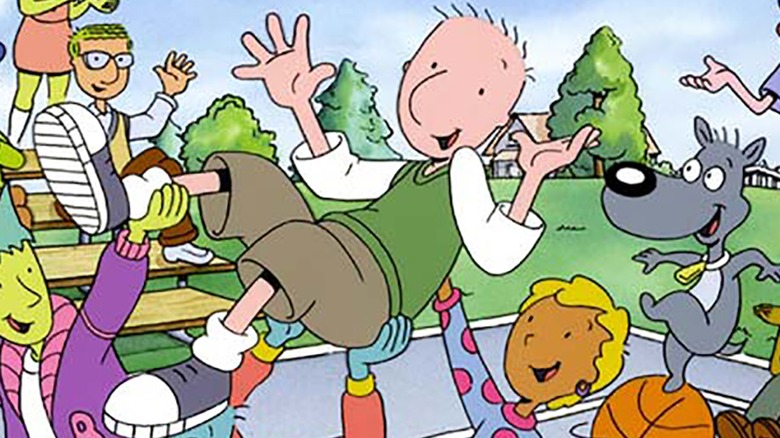
Not all cartoons have to be about superheroes, space adventures, or anthropomorphic animals. Sometimes, it's enough to tell the story of one kid, his friends, and the town they're growing up in. Such is the case with Doug, the 1991 animated series about a boy who loves his dog, his banjo, and hanging out with his best friend Skeeter at the Honker Burger.
Doug is entirely original, not based on a comic book, toyline, or movie property, like so many other cartoons of the 1990s. It was one of the first Nicktoons, along with Ren & Stimpy and Rugrats, and was so extensively developed, it had a show bible that detailed the floor plans of its characters' houses. Today, Doug is remembered for its stylish animation, heartfelt storytelling, and unconventional soundtrack. Yet much of Doug goes over the heads of its youngest viewers. From the subtlest character choices to the most overt references, these are the Doug details only adults appreciate.
Dear Diary...
Douglas Yancey Funnie is a shy, self-conscious kid. When he isn't drawing, playing his banjo, or working up the courage to talk to Patti Mayonnaise, he's daydreaming. Doug's world, and the cartoon that chronicles it, is hugely interior: Doug's journal, chock-full of superhero drawings and l'esprit de 'l'escalier comebacks, is the backbone of the show.
This deeply personal approach is by design: Doug was created by Jim Jinkins as a largely autobiographical take on adolescence. Jinkins tried to sell Doug as a greeting card line and children's book before a version of the character wound up in a grapefruit commercial. Ultimately, Jinkins' creation took root at Nickelodeon, in large part because of its honest, down-to-earth storytelling.
Executive Producer Vanessa Coffey had worked on cartoon giants like Teenage Mutant Ninja Turtles for other networks, and had grown tired of their violence and commercialism. Jinkins' Doug was a breath of fresh air, and Coffey had a hunch kids would respond to it. She was right: 98% of a test group of 800 kids enjoyed Doug. "It's sad," Coffey expounded, "There are shows you can give children that are smart, that will appeal to them. Kids like to think. They don't want to be given guns and sugar." In that sense, Doug's down-to-earth spirit is something kids and adults appreciate. But only the latter group truly understands how daring the series is — especially at the time of its creation.
Disney's Doug
After 52 glorious episodes, Doug's creators prepared to produce a final season, as Nickelodeon had previously ordered — only to find that Nick was no longer interested in funding it. Disney still saw promise in Doug, however, and Jinkins had more stories to tell, so the Funnie family moved to the Mouse House. Under Disney, Doug would remain profitable — even more so with a marketing machine behind it — and produce another 65 episodes, as well as a movie.
But Disney brought some major changes to Bluffington. Doug himself aged another year, and his family welcomed a younger sister named Cleopatra Dirtbike Funnie. Roger Klotz became rich. The Honker Burger vanished. Most noticeably, Doug's voice actor, the legendary Billy West, was replaced by Tom McHugh. Jinkins wanted West to return, but Disney had pushed him too far by asking him to do additional voices for the same amount of money.
Though kids noticed the changes, they had to grow up to truly grasp the reasons behind the revamp. It is obvious to adult eyes that all of these changes made Doug a whole lot less complex, and a whole lot more commercial. Disney's Doug isn't terrible, but it gives kids a lot less to wrestle with. As Patti Mayonnaise's voice actress Constance Shulman put it, Disney "just dimmed the magic."
Relationships of every stripe
Patti Mayonnaise is the girl of Doug's dreams. But she's also one of the audience's first encounters with Doug's multifaceted approach to relationships and romance. Patti is kind, brave, and smart — and the child of a single father. Later, her father remarries, and Patti experiences life with a step-parent. Roger is the child of a single mom, the Dinks are married without children, Chalky lives with his dad and older brother — Bluffington features all sorts of families built around all sorts of relationships.
This openness and maturity extends to the show's portrayal of dating and romance. In "Doug & Patti Sittin' in a Tree," Doug attempts to distill dating into discrete steps ... only to learn, of course, that no relationship can be turned into an equation. The lesson hammered home over and over again over the course of the series is that love is personal, and never a game to be won or lost — a lesson many adults could still stand to learn.
But it's not all high-minded idealism when it comes to Doug's portrayal of adolescent feelings — there are more than a few sly jokes snuck into the series. For example, when Roger realizes his cat has had kittens, he exclaims that he doesn't know how to tell their sex. His mother, exasperated, says they are "way past due for a very important talk." Cue parental laughter and kid confusion.
The bully's-eye-view
Bullying is very much a part of Doug. Creator Jim Jinkins was working from personal experience — He actually invited his childhood bully to the premiere of Doug's 1st Movie, only to discover the kid in question had been contending with bullies of his own. No surprise then that the cartoon's depiction of bullying is complex, encompassing the pain they cause as well as the pain they are acting out of.
Roger Klotz is Doug's particular tormentor, and is remarkably fleshed out over the course of the series. Fans see Roger struggle with being held back in school, first crushes, and growing up poor. He and Doug end up something close to friends in the end, to the point that Doug is the only person Roger trusts to take care of his beloved cat. Kids appreciate seeing their struggles on screen, but only adults understand how daring Doug truly is in depicting Roger's circumstances with such honesty. Nothing he's gone through makes bullying okay, but it does make it comprehensible, and understanding that is what enables real, lasting change.
All the color, none of the race
Mosquito "Skeeter" Valentine is commonly understood to be African-American, despite the fact that he's, well, blue. Though Jim Jinkins enjoys this interpretation, he maintains that he simply thought the character looked good blue. It turns out that he was bored with normal skin tone colors in his art, and after downing several drinks one afternoon, he and co-creator David Campbell committed to the unconventional design choice.
Many involved in Doug's creation have said this was a deliberate choice, meant to dissolve the divisions between characters. Others, however, have offered a different take. Executive producer Doug Campbell had this to say: "Look, we're not black people, we're not Mexican, but we want the cartoon to speak to all groups. How do we get past the barrier of ethnicity? And [Jinkins] said, 'Let's try coloring them all different colors.'" Moreover, Nickelodeon founder Gus Hauser has admitted that the fact of Nickeolodeon's cable status was a factor — only kids from families who could afford Doug would be watching, and they took that into account.
Modern critics disagree as to whether or not Doug's literal rainbow of characters is a progressive statement or a regressive concession. This debate, however, is largely invisible to kids — until they grow up, pull up an episode, and find themselves wondering what Doug's choices mean in a world where no one is blue, but color continues to matter.
The mysterious Mr. Dink
Bud Dink is Doug's closest adult friend and next door neighbor. His name is itself a joke only adults will grasp: "Dink" riffs off "Dual Income, No Kids," a phrase first coined to describe affluent couples of the Yuppie era. Bud, who is never without some new gadget he is eager to describe as "very expensive," is DINK life incarnate.
Some grown-up viewers, however, think there is something entirely more sinister about Mr. Dink going over young heads. One fan theorist (who admittedly specializes in "dark, twisted Nicktoons theories") interprets Mr. Dink as an outright pedophile. The evidence? For one thing, Mrs. Dink doesn't ever seem to enjoy her husband's company, to the point that it's easy to see their marriage as one of convenience. Then there's the eagerness with which he befriends Doug, who thinks "Mr. Dink is nice, but ... a little crazy." Then there's the time he takes Doug's picture from the bushes, which he claims was an accident, and the time he ends up naked while leading the Bluff Scouts on a camping trip, and all the times he lends his kid neighbor expensive toys, despite the fact that they often end up broken...
This is all, of course, fan speculation — no one believes Doug's creators ever saw Mr. Dink as anything but a kind, if slightly odd, mentor figure. But it takes an adult mind to twist him in this direction, and, well, that's exactly what's happened.
Makeovers, body image, and weight loss camp
Body image is one of the great specters of adolescence, and Doug tackles it repeatedly. The episode "Doug's Chubby Buddy," sees Patti develop an eating disorder after being exposed to celebrity diet culture and weight loss supplements. The episode originally ended with Patti's voice actress Constance Shulman giving information about eating disorders, but the reruns dubbed this over with an argument between Skeeter and Roger. "Doug Tips the Scales" sees our hero deal with body anxiety himself, when he becomes obsessed with losing weight for a pool party.
It takes an adult to fully appreciate how heartfelt and honest these episodes are. Few cartoons touch on the pressure to diet with such subtlety — fewer still examine it through male and female characters. But this nuance disappeared once Disney took over Doug. Connie Benge, depicted in the Nickelodeon episodes as zaftig, becomes suddenly svelte in the Disney era. This is a disappointing choice in and of itself, made worse by the fact that she credits the change to a summer at what is implied to be a weight-loss camp. Gone was Doug's critique of the pressure to lose weight, present, suddenly, was ... well, the pressure to lose weight. This is one detail only adults grasped the full meaning of, much to their frustration.
Diary of an anxious kid
Doug is characterized by its down-to-earth portrayal of romance, self-esteem, bullying, and cliquishness. One of its more unsung virtues, however, is just how well it depicts anxiety. Doug is an eleven-year-old who simultaneously wants to be normal and stand out from the crowd — an explosive cocktail of adolescent angst adults remember all too well. The result? Boatloads of anxiety, depicted with a sensitivity that remains uncommon in cartoons.
This is very much by design. Creator Jim Jinkins has remarked before on the "dark things" Doug is rooted in, many drawn from his own childhood. Like many young people, Doug struggles with fears of inadequacy, failure, and strangeness, retreating into fantasy and self-recrimination when he is overwhelmed. There is an unvarnished truth to Doug's moments of doubt, made all the more effective by the fact that his anxieties aren't a one-time thing — they're one of the show's most enduring features. He is, like any kid, figuring out what kind of person he wants to be, a process that involves a whole lot of embarrassment, anger, and fear. Kids are drawn to this aspect of the show for sure, but only adults understand how rare such openness about anxiety truly is, even in grown-up entertainment.
What is, and almost was
Doug's legacy has proven to be lasting. The show spawned its own stage show, video game, movie, and even a series of mystery novels. Most important of all, however, is the impression it made upon its fans. Adults who loved the show as kids lovingly parody the cartoon, record acoustic covers of songs by Doug's favorite in-universe band, lament the changes wrought by Disney, and speculate about the property's future in ways only adults can. In this age of reboots and 1990s nostalgia, a grown-up reared on Nicktoons can't help but wonder — what does the future hold for Doug Funnie and his pals?
Disney currently owns the rights to Doug and seemingly has no interest in revisiting Bluffington any time soon. But creator Jim Jinkins has ideas for a second movie ready to go, aimed at the kids who grew up with his creation. This iteration of Doug would follow him to the big city, where he would live with Skeeter, pursue a career as a freelance artist, and cheer on his sister Judy's "off, off, off Broadway" performance art. Though it would assuredly deal with more mature topics than the cartoon, it wouldn't exactly be grim — Porkchop would stick around, as Jinkins is committed to ignoring "dogs and their real lifespans." Will it ever see the light of day? Who knows — but adult fans will be glad to know it's out there.
Credits: Stephen Wilds